From Busy Professional to Ultra Winner: Mac Dewar’s Year of Structured Training
Last update February 13th, 2026 by Etienne Durocher
A year that changed everything
In endurance sports, progress is often portrayed as linear. More mileage. More intensity. Better results. But for most busy professionals, life does not unfold in neat training blocks. Careers evolve. Projects stack up. Energy fluctuates. Time becomes the rarest resource.
Mac Dewar’s last year of training tells a different, more realistic story. One that resonates deeply with runners who want to challenge themselves without putting the rest of their life on hold.
In the span of twelve months, Mac won his first ultramarathon at Frosty Mountain 50k, completed his first 100 km race in Snowdonia, Wales, finished 9th overall at the Knee Knacker 50k, and set personal bests in both the Half Marathon and Marathon. He did all of this while navigating a major career change, launching a new business, buying property, and maintaining personal relationships.
This is not a story of perfect conditions. It is a story of structure, flexibility, accountability, and learning how long-term training can fit around a busy life, not compete with it.
Before coaching: motivation without structure
Before working with Philotimo Running Coach in June 2024, Mac’s relationship with running was enthusiastic but inconsistent. He loved racing. He loved the challenge. But his training lacked direction.
Two runs per week felt like a good week. Recovery was an afterthought. Preparation for races was largely intuitive rather than intentional.
“I was having fun but knew there was more to unlock by finding knowledge and accountability.”
Like many busy professionals, Mac wasn’t lacking motivation. He was lacking clarity. Without a long-term plan, each week became reactive. Training fit where it could, often at the expense of consistency.
The goal was not to train more for the sake of training more. It was to build something sustainable.
Learn how this fits into a complete running strategy: Marathon Shoes: Choosing the Right Running Shoes For Your Marathon
Building structure around real life
From the beginning, the coaching approach was clear: training had to work with Mac’s life, not against it.
As someone constantly balancing multiple projects, flexibility was non-negotiable. Late-night runs. Shifted sessions. Occasional trade-offs between training days and other passions like backcountry skiing.
When opportunities arose outside of running, the plan adapted.
A defining moment came in the fall when Mac entered the process of buying property, a time-consuming and mentally demanding period.
“The flexibility and expertise meant we could customize not just my weekly mileage but also the intensity, allowing me to exceed my goals while running one less day per week.”
This adaptability is often misunderstood as lowering standards. In reality, it demands greater precision. Knowing which sessions matter most. Knowing when to push and when to protect long-term consistency.
The breakthrough: Frosty Mountain 50k
Mac’s first ultramarathon was never about winning. It was about stepping into unknown territory.
Yet at Frosty Mountain 50k, preparation met opportunity.
Winning his first ultra reshaped his self-belief.
“It showed me that what I had been doing was working and that a lot more was possible.”
Beyond the result, the race instilled a new sense of responsibility. Confidence must be paired with patience. One breakthrough does not eliminate the need for process.
This would become essential as distances increased and challenges compounded.
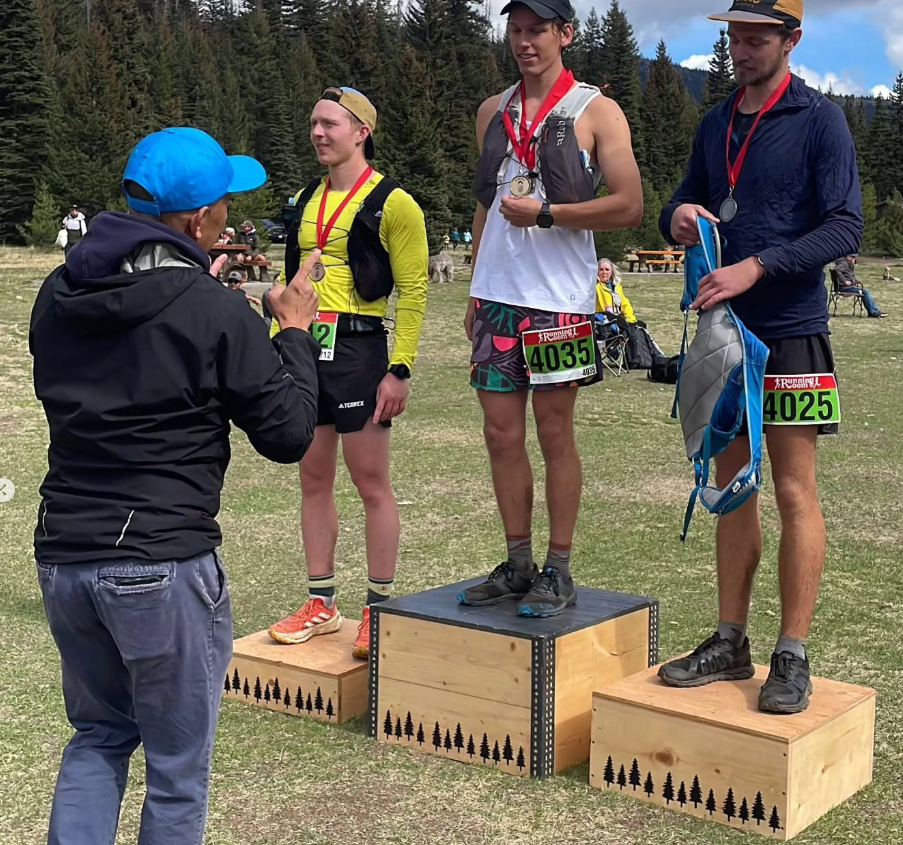
Frosty 50k Celebration - 2024
Winning his first ultra reshaped his self-belief.
“It showed me that what I had been doing was working and that a lot more was possible.”
Training across distances: Half Marathon to 100 km
One of the most surprising lessons Mac encountered was how different training stressors affected him across distances.
“Intensity wasn’t as much of a bottleneck as building and maintaining weekly mileage.”
Multiple interval sessions at faster paces felt manageable. High-volume weeks, even at lower intensity, demanded far more discipline.
Balancing road racing with ultramarathon preparation revealed an important truth: endurance development is cumulative. Speed helps, but durability decides.
The fall season focused on speed and confidence, laying a foundation for future ultra performance. But it also revealed the risks of mental fatigue.
“Building for the long term is about falling in love with the process rather than pushing for a result.”
For runners navigating demanding careers, young families, or major life transitions, this is often the turning point. Structure does not mean rigidity. It means knowing which sessions matter, which ones can move, and how to build fitness without draining the rest of your life. If you recognize yourself in this phase — motivated but stretched thin — working with a coach can remove the guesswork. A clear framework built around your schedule can unlock performance you may already be capable of, without adding chaos to your week.
This topic works alongside: Review of the 2024 Blog Page
Snowdonia 100k: redefining what’s possible
If one race defines Mac’s year, it is the Snowdonia 100k in Wales.
A mountainous course. International travel. A lingering injury that complicated the build.
On paper, it was an unreasonable goal.
In practice, it became a lesson in breaking the impossible into manageable steps.
“Working through a poorly timed injury, going and doing a crazy thing halfway across the world… it became more about the process than the result.”
Crossing that finish line represented more than distance covered. It reflected mental endurance, trust in preparation, and the power of shared support from friends and strangers alike.
Racing mindset: from uncertainty to confidence
Across the season, Mac’s approach to racing matured.
The curiosity remained.
“Let’s see what I can do.”
But it was now paired with deeper body awareness and confidence. Knowing when to push. When to compete. When to race his own race.
This evolution was evident at Knee Knacker 50k, where experience guided decision-making more than emotion.
High performance, Mac learned, is not about aggression. It is about restraint applied at the right moments.
Career change and reduced stress
Midway through the year, Mac transitioned from engineering into bespoke furniture making.
The impact on training was immediate.
“The stress from my work dramatically reduced. Running became a passion rather than an escape.”
This shift highlights an often-overlooked aspect of performance: emotional energy. Reduced stress created space for enjoyment, which in turn supported consistency.
Training thrived not because life became easier, but because it became more aligned.
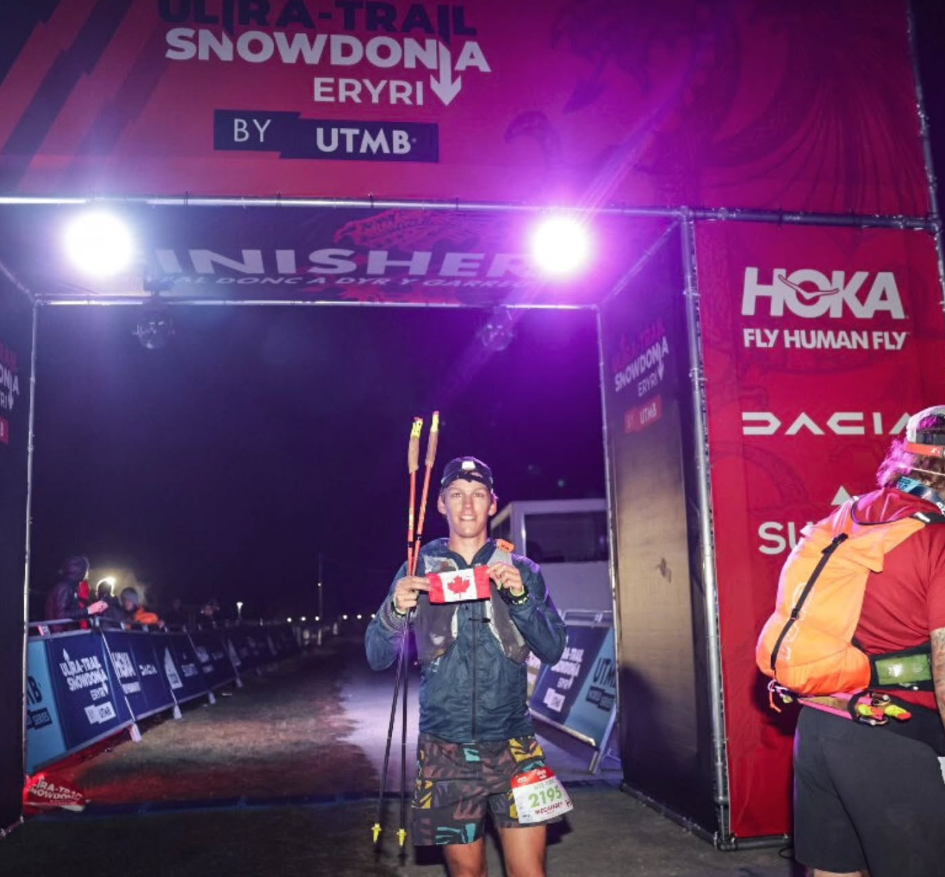
Mac at the finish line of Snowdonia 100k
True progress now depends on patience, trust, and long-term commitment.
“At a certain point I realized I didn’t just want to perform this year or next, but to reach a level that simply requires time in the game.”
Communication, trust, and accountability
No training plan survives real life without communication.
Mac describes learning to rely on support as a key growth area.
“Communication and trust are absolutely vital to my success as a runner.”
Adjustments were made when fatigue surfaced or schedules shifted unexpectedly. Accountability was shared, not imposed.
This relationship allowed training to evolve without derailing momentum.
Real-life high performance
Elite results are often associated with ideal conditions. Mac’s experience tells a different story.
“Conditions will never be perfect. It’s about committing to yourself and saying ‘I’m going no matter what.’”
Late-night runs. Rain. Snow. Sessions completed because they were in the calendar and mattered.
These are the moments that define progress.
Redefining success
Balancing running with buying property, launching a business, and maintaining relationships reshaped Mac’s definition of success.
“For me there is joy in the chaos. I define success as having lived a full life.”
Results follow engagement. Not the other way around.
Habits that mattered most
Looking back, framing the year as a season provided continuity.
Even with breaks, the long-term vision remained intact. Goals were justified. Commitments felt meaningful.
“No matter how hard one session was, it was the next 200 sessions that mattered.”
Patience replaced urgency. Sustainability replaced intensity for intensity’s sake.
Where the journey continues: a new phase of trust and commitment
What makes this story particularly meaningful is that it is not finished.
Mac and Philotimo Running Coach are still working together, now entering a new phase of the athlete–coach relationship. One that is quieter on the surface, but deeper in intention. Less about chasing the next breakthrough and more about building a foundation that can support performance for years to come.
After a year filled with milestones, travel, racing, and personal change, both athlete and coach reached a shared understanding: true progress now depends on patience, trust, and long-term commitment.
“At a certain point I realized I didn’t just want to perform this year or next, but to reach a level that simply requires time in the game.”
This is where the work has shifted.
Rather than stacking races or constantly pushing intensity, the current focus is on becoming faster overall by becoming stronger at the base. That means re-establishing fundamentals that are often overlooked by driven, capable runners.
At the center of this new phase is easy running, particularly Zone 2.
The current work is deliberately simple, but not simplistic. What makes this phase powerful is the mutual commitment behind it. The athlete commits to consistency and honesty. The coach commits to clarity, restraint, and long-term vision.
Together, this creates a training environment where progress is measured not only by results, but by sustainability, confidence, and the ability to keep showing up over time.
The goal now is not a single race, but a way of training that supports a full life while continuing to raise performance ceilings. Getting faster, stronger, and more resilient not through shortcuts, but through intelligent, sustainable work.
This is often the most challenging phase for high-achieving individuals. It lacks spectacle. It demands humility.
One sentence to define the year
“The most challenging, most rewarding year I’ve ever had.”
This naturally leads into: How to Build Mental Toughness for Running
An invitation
Mac’s journey is not unique because of his results. It is unique because of how intentionally those results were built within a full, demanding life.
For runners who believe they are too busy to train seriously, his story offers a different perspective.
With the right structure, flexibility, and support, ambitious goals do not require perfect conditions. They require commitment, patience, and a plan designed for real life.
This is the philosophy behind Philotimo Running Coach. Not training at the expense of life, but training as part of a life fully lived.
If you are preparing for your first ultra, chasing a breakthrough marathon, or simply trying to train consistently while building a career and a life you care about, the path forward does not require perfect conditions. It requires clarity, accountability, and a long-term vision. If you are ready to build durable fitness that fits your reality, Philotimo Running Coach offers structured, personalized coaching designed for ambitious runners who refuse to choose between performance and a full life.